Advanced Email Forensics for macOS.
Parse raw RFC-5322 headers, trace transit routing paths hop by hop, and generate PDF analysis certificates — on your Mac.
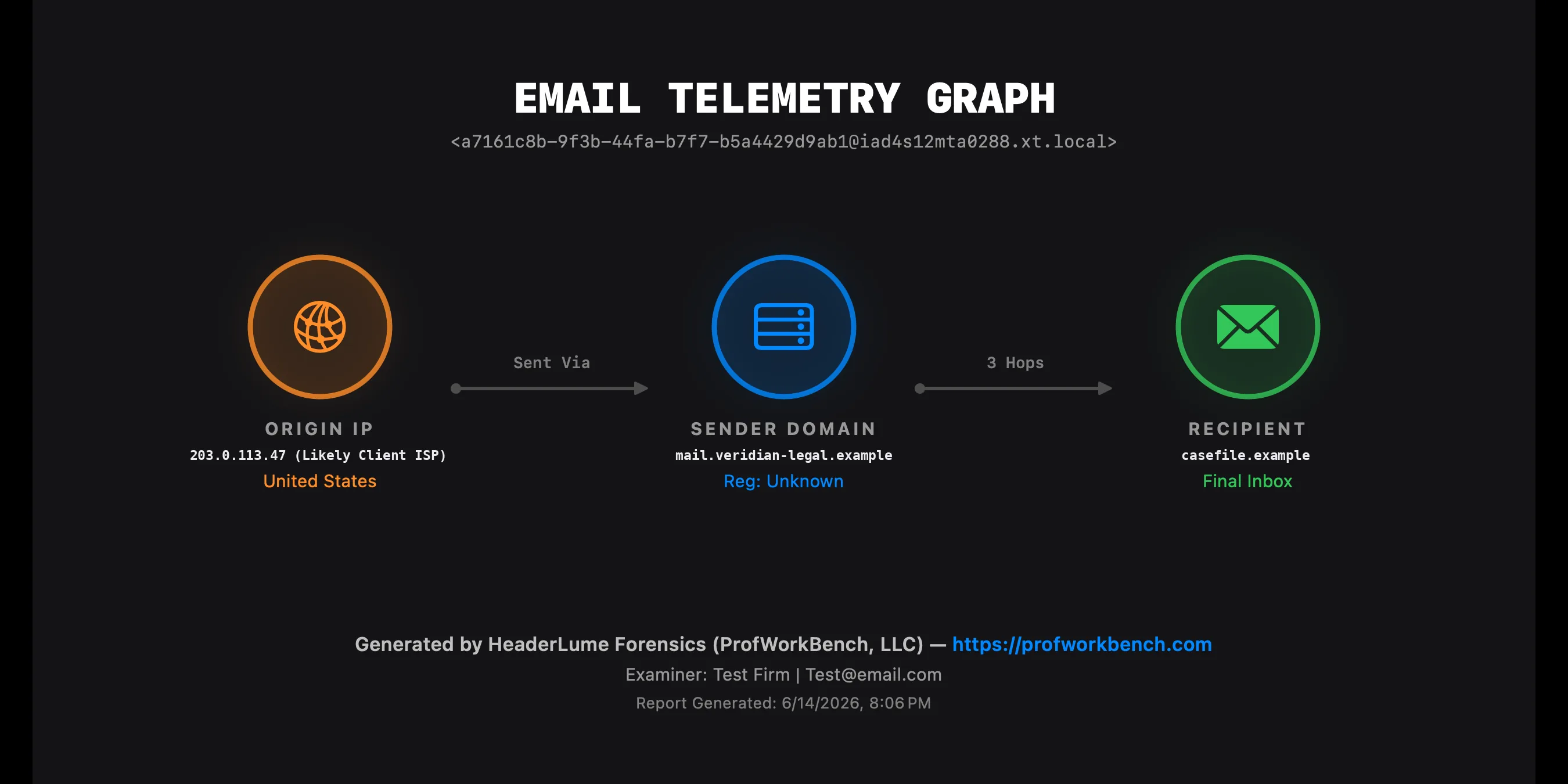
Watch a header confess.
Load a sample forensic header and watch a replay of what HeaderLume 27.0 reports for it, hop by hop.
A full forensics lab. The core analysis needs no network.
Purpose-built for examiners, litigators, and incident responders who can't afford to leak evidence to the cloud.
On-Device MIME Parser
Raw RFC-5322 header parsing executed fully on-device. The message itself never leaves the examiner's machine.
Transit Route Mapping
Pins relay hops on an Apple Maps view where ipwho.is returns a location for a hop's address (with Zero Telemetry off; not every hop gets a pin): the lookup's location, not a measured path. Flags hops whose timestamps run backwards.
Authentication Traffic Lights
The SPF, DKIM, DMARC and ARC results recorded in the message's Authentication-Results headers, shown at a glance as pass, fail or unknown — transcribed, not re-checked.
E-Discovery Load Files
Automatic generation of a Concordance .DAT load file and an Opticon .OPT image load file (one row per document, pointing at its multi-page PDF certificate with its page count), packaged in one ZIP with the original messages.
Memory-Efficient MBOX Analysis
Analyze giant mailbox archives (10GB+) in the background: the archive is memory-mapped and split message by message, so a multi-gigabyte file does not have to fit in RAM.
Zero Telemetry
One switch that blocks every optional outside lookup the app can make.
Built for the examiner's bench.
Native macOS, dark by default, engineered for long analysis sessions. Click through the workflow.
Manual header reading doesn't scale. Or hold up.
Anyone can squint at a Received chain. Producing defensible, repeatable findings is a different job.
| Task | Reading headers manually | Generic web checkers | HeaderLume |
|---|---|---|---|
| Parse a full Received chain | Minutes, error-prone | Partial | Instant, every hop |
| Relay delay anomaly detection | Manual math per hop | No | Automatic Δ-analysis |
| SPF / DKIM / DMARC / ARC results | Read field by field | Basic | Traffic-light instant |
| Evidence confidentiality | Local | Uploads to third party | On-device, sandboxed |
| 10GB+ MBOX archives | Impractical | Upload limits | Memory-mapped, in the background |
| Reporting output | DIY formatting | Screenshots | PDF certificates + .DAT/.OPT |
Findings your opposing counsel can't wave away.
Every HeaderLume analysis certificate carries its generation time (UTC); a single-message certificate also prints the examiner details you enter in Settings and, with the original message attached, its MD5, SHA-1 and SHA-256, and an e-discovery production records each document's MD5 and SHA-256 in its .DAT load file — the metadata foundation for authenticating electronic records.
Because the analysis runs on your Mac, the message itself never leaves it and your chain of custody stays intact. HeaderLume ships with Zero Telemetry off, so on each single-message analysis it sends hop addresses to ipwho.is and the sender's domain to rdap.org, which redirects HeaderLume to that domain's registry, so your Mac sends the domain there too. When a lookup returns an answer, the certificate names its service; other hop addresses looked up for the map are not listed on it. With your key, each attachment's SHA-256 also goes to VirusTotal. Turn Zero Telemetry on and HeaderLume makes none of these lookups.
Concordance .DAT and .OPT exports drop straight into Relativity and other review platforms your litigation-support team already runs.
Self-authenticating electronic records
Rules 902(13) and 902(14) let a record generated by an electronic process, or a hashed copy, be authenticated by a written certification instead of live foundation testimony — provided the certifying person is qualified and notice is given. HeaderLume produces the record and the hashes; the certification is yours to give.
Repeatable, documented process
Deterministic parsing of published standards (RFC 5322 message format, RFC 5321 trace fields, and the RFC 8601 Authentication-Results field) means another examiner can reproduce your findings step-for-step.

Where HeaderLume goes to work.
The same parser, three very different benches.
Litigation & eDiscovery
Examine disputed emails, flag spoofed chains, and hand PDF analysis certificates to counsel — a single-message certificate prints the examiner details you enter in Settings and, with the original attached, its SHA-256. Load files use the Concordance .DAT / Opticon .OPT formats that review platforms such as Relativity load.
Incident Response
Triage phishing and BEC campaigns in seconds: follow the Received chain back to the earliest hop it records, read the SPF/DKIM/DMARC results transcribed from the message's Authentication-Results headers, and spot hop timestamps that run backwards — on privileged material, with every outside lookup HeaderLume makes named and switchable off.
Forensic Labs & Law Enforcement
Process entire custodian mailboxes — 10GB+ MBOX archives are memory-mapped and analyzed in the background — inside a workflow whose chain of custody never leaves your bench.
Evidence-grade tooling, at every scale.
Free to download. A licence unlocks analysis.
- Look around the main window — the analysis screens need a licence
- Read the built-in user guide
- Set your privacy and lookup preferences
- Unlimited EML / MBOX parsing
- Transit route mapping
- E-discovery load-file exports
- PDF analysis certificates
- Lifetime license, all future major upgrades
- Priority developer support
- Direct line to the developer